


Mission en Islande
Quatre jours sur la route avec les photographes Emil Sollie et Hallvard Kolltveit
Quatre jours sur la route avec les photographes Emil Sollie et Hallvard Kolltveit
Un road trip de quatre jours
En octobre, nous avons accompagné les photographes Emil Sollie et Hallvard Kolltveit lors d’un voyage en Islande. Ces deux Norvégiens parcourent le monde comme photographes lifestyle et publicitaires, et cette fois, ils réalisaient avec des amis une séance pour la marque d’équipement de voyage Db. Nous avons équipé l’équipe de vestes Scandinavian Edition pour la protéger du climat rude de l’Islande.
Jour 1
Notre vol a quitté Oslo tôt le matin, et nous avons atterri à Keflavík à 8 h sous un magnifique lever de soleil. Avec deux 4x4 chargés, nous avons pris la route de Vík, notre première étape dans le sud de l’Islande. Sur le papier, le trajet dure trois heures – en réalité, il faut en compter trois à six de plus pour les arrêts panoramiques. Au bout de trente minutes, nous avons aperçu le premier sommet couvert de neige fraîche. Une courte séance photo, et nous étions de nouveau sur la route.


Le temps file quand on roule en Islande – trois heures ont semblé en durer une et demie. Les routes sont étonnamment droites, et il y a toujours une cascade, un glacier ou un sommet à admirer. Nous nous sommes arrêtés à Skógafoss, une cascade de 25 mètres de large et 60 mètres de haut. Prévoyez une veste imperméable : l’air est chargé d’embruns, et nos vêtements se sont vite couverts de fines gouttelettes.

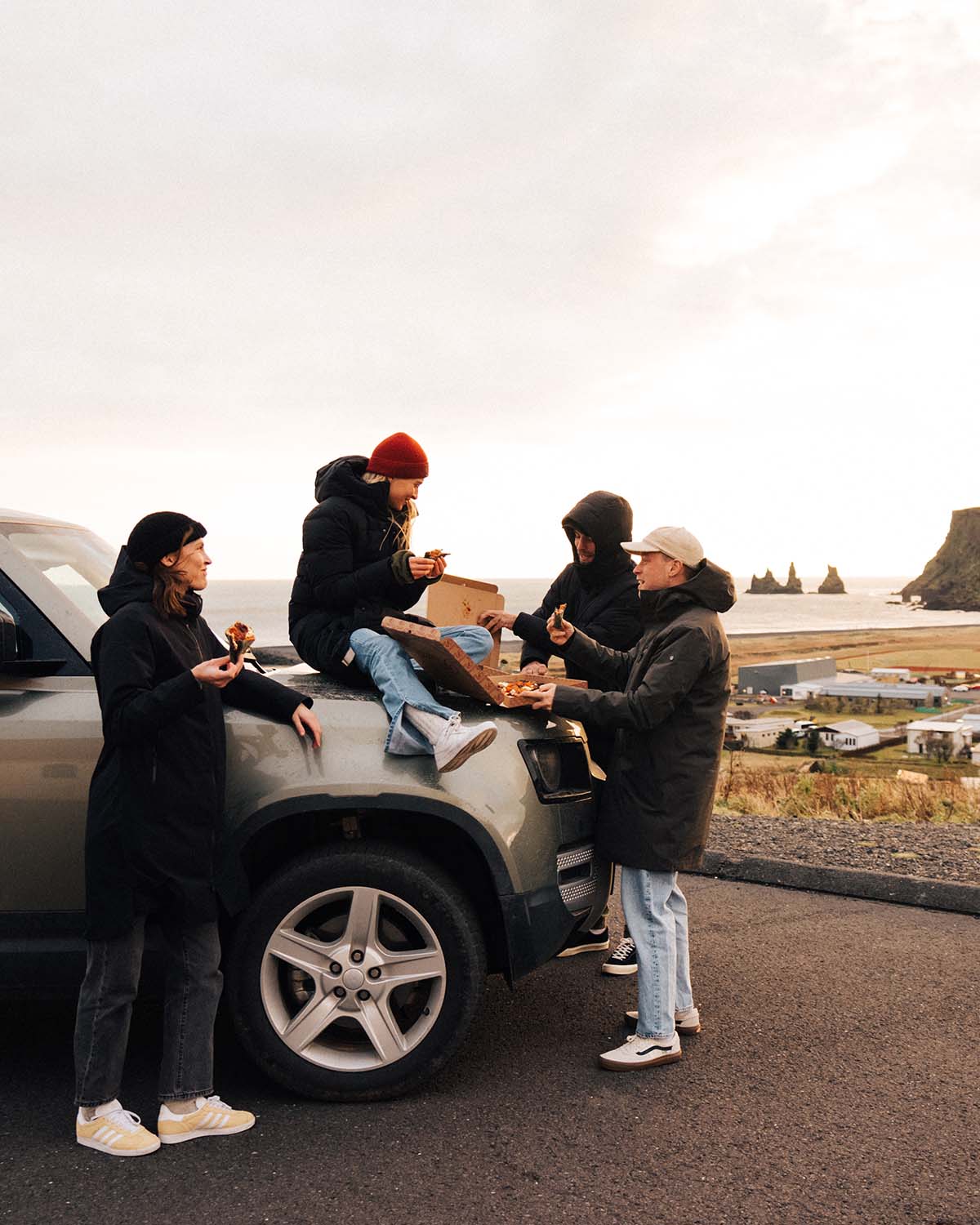
Nous sommes arrivés à Vík en fin d’après-midi. C’est sans doute l’un des lieux les plus photographiés d’Islande, et on comprend vite pourquoi : un littoral spectaculaire, des plages noires et des falaises escarpées, avec des montagnes coiffées de glaciers en arrière-plan. Le vent du nord soufflait fort, mais cela ne nous a pas empêchés de manger une pizza en regardant le soleil se coucher sur le village.


Jour 2
Le réveil a sonné à 5 h 30 pour rejoindre Jökulsárlón, la plus grande et la plus célèbre lagune glaciaire d’Islande, à deux heures et demie au sud-est de Vík, au pied du glacier Vatnajökull. C’était l’objectif principal du voyage : Emil et Hallvard photographiaient la nouvelle collection Glacier Green de Db, en plaçant les sacs dans un paysage glaciaire pour en faire ressortir la couleur. Jökulsárlón est un spectacle impressionnant, avec d’immenses blocs de glace verts et bleus qui flottent dans la lagune.

Hallvard en Loft, Olive foncé

Kristin en Meridian, Onyx
Prochaine étape : le village de pêcheurs de Höfn pour un en-cas rapide, avant de rejoindre Stokksnes pour une séance au coucher du soleil. À vingt minutes de Höfn, Stokksnes est connu pour les spectaculaires montagnes du Vestrahorn, qui culminent à 454 mètres et plongent directement sur une plage de sable noir. C’est un endroit magique – on peut même y trouver une vague à surfer (nous l’avons fait) – et on y passe facilement des heures à se promener.

Après un repas chaud dans nos appartements, Hallvard a repéré les premiers signes d’aurores boréales derrière une montagne sur le chemin du retour. Après deux ans passés aux Lofoten, il s’y connaît : prévoyez une longue nuit, a-t-il dit – elles sont généralement les plus intenses entre 1 h et 3 h du matin. Plus tard dans la soirée, nous sommes retournés à Jökulsárlón pour voir s’il avait raison. Après quelques heures d’attente, la magie a commencé. Cela valait chaque minute d’une nuit glaciale.


Jour 3
Nous nous sommes réveillés sous une météo typiquement islandaise : un vent du nord violent, avec de la neige et du brouillard descendant des montagnes. Le seul programme était de parcourir les 500 kilomètres jusqu’à Reykjavík, alors nous nous sommes laissé guider par la route.


Une heure après le départ, Hallvard a tourné brusquement à droite sur une piste de gravier. « Regardez cette langue glaciaire qui descend dans la vallée, a-t-il dit. Je pense qu’on peut monter jusqu’en haut avec les 4x4. » Jusque-là, nous n’avions pas vraiment exploité les capacités des voitures – la plupart des arrêts se trouvaient près des routes principales. Cette fois, c’était autre chose : 20 kilomètres de gravier accidenté, des nids-de-poule remplis de glace et d’eau, et une rivière à traverser avant d’atteindre le pied du glacier.
Sans rien pour l’arrêter, le vent était plus fort que tout ce que nous avions connu jusque-là – des rafales de plus de 20 mètres par seconde ont failli nous soulever du sol en sortant des voitures. Se tenir au bord d’un glacier, loin de tout, en ressentant la force brute de la nature, a été l’un des temps forts du voyage.

À l’approche de Reykjavík, le coucher de soleil a été un autre temps fort. Le vent avait soulevé du sable volcanique dans le ciel, qui s’est embrasé comme du feu – une fin à la hauteur de notre road trip dans le sud-est.


Jour 4
Après trois jours dans des lieux où le prochain restaurant peut se trouver à deux heures de route, nous avions envie de retrouver la ville. Reykjavík est la capitale la plus septentrionale du monde, au sud-ouest de l’île, et assez petite pour être explorée à pied.


Impossible de manquer Hallgrímskirkja, l’église de 74 mètres qui est le plus haut bâtiment de la ville – seul un immeuble de bureaux de la banlieue de Kópavogur la dépasse.

L’équipe, de gauche à droite : Veslemøy (@veesla), Eivind (@eivlea), Hallvard (@hallvardkolltveit), Kristin (@kristinsaunes) et Emil (@emilsollie).
Carnet de voyage


Habillé pour la météo
 Nimbus — Bleu nuit
€399.00
 Range III — Bleu nuit
€479.00
 Hood II — Cèdre
€349.00
 Tyo — Carbone
€599.00
 Urban II — Onyx
€749.00
 Map II — Brun foncé
€249.00
 Ratio III — Graphite
€289.00
 Trip II — Brun foncé
€299.00
 Link — Bleu nuit
€399.00
 Meridian II — Onyx
€849.00
 Swell III — Bleu nuit
€699.00
 Veil II — Kaki
€349.00
 Flair Short — Cèdre
€399.00
 Acme II — Onyx
€599.00
 Leeway — Carbone
€429.00
 Block II — Onyx
€549.00
 Cover II — Olive foncé
€599.00
 Node II — Kaki
€389.00
 Air II — Graphite
€359.00
 Prevail — Onyx
€649.00
 Port Shorts — Bleu marine
€119.00
 Drift Shorts — Bleu marine
€129.00
Prévisions : MET Norway, CC BY 4.0
A Four Day Adventure Road Trip
In October, we tagged along with photographers Emil Sollie and Hallvard Kolltveit to Iceland. The two Norwegians travel the world as lifestyle and commercial photographers. For their trip to Iceland, they were on a mission with friends to shoot for travel gear company Db. We equipped the crew with Scandinavian Edition jackets to protect them from Iceland's harsh climate.
DAY 1 — Arrival and the first sight of snow
Our flight to Iceland left Oslo Airport early in the morning, and we arrived at a beautiful sunrise in Keflavik at 8 AM. After packing our two 4x4s, we drove towards Vík—our first destination in the southern part of Iceland. The drive is 3 hours on paper, but you will probably spend an extra 3 to 6 hours for scenic stops. We stopped 30 minutes into our drive—spotting the first mountaintop covered with fresh snow. Then, after a quick photo session, we continued our drive south.


Time flies when you are driving in Iceland—3 hours felt like 1,5. The roads are surprisingly straight, and there is always some waterfall, glacier, or mountaintop to look at, which takes your mind off the distance. We stopped at the famous Skógafoss—a 25 meters wide and 60 meters tall waterfall. Ensure to bring a waterproof jacket when visiting waterfalls as the air in the area was filled with water spray—our clothes were quickly covered with tiny drops of water.

We arrived in Vík late in the afternoon and explored the area. Vik is probably one of the most photographed places in Iceland. Still, it is easy to understand why—the place is super scenic, with a dramatic stretch of coastline, black beaches, and rugged sea cliffs combined with glacier-topped mountains in the background. The northern winds were blowing super hard, but that did not stop us from having pizza as we watched the sunset overlooking town.
DAY 2 — Time to shoot some Glaciers
The alarm was set for 05:30 the next day for our drive to Jökulsárlón—Iceland's largest and most famous glacier lake. Jökulsárlón sits below the glacier Vatnajökull and another 2,5 hours drive southeast of Vík. Jökulsárlón was our main destination for the trip. Emil and Hallvard were shooting content for the new Glacier Green collection for Norwegian travel gear brand Db. The idea was to place the bags in a glacier environment to showcase the color. Jökulsárlón is an impressive sight—colossal green and blue ice blocks are floating around in a lake below the glacier.

Hallvard is wearing Loft in Dark Olive
View Details
Kristin is wearing Meridian in Onyx
View DetailsNext, we headed to the fishing village of Höfn. We had some light snacks before driving to Stokksnes for a sunset shoot. Stokksnes is located 20 minutes outside of Höfn and is known for its dramatic, Game of Thrones-looking mountains named Vestrahorn. The mountain range tops at 454 meters and drops straight down onto a black sand beach. It is a magical place where you can even find a wave to surf (which we did). You can easily spend a couple of hours just walking around and soaking up the magic of this place.

After Stokksnes, we drove to our hotel apartments and enjoyed a hot meal. On our way home in the dark, Hallvard spotted some early signs of Northern Lights peaking up behind a mountain. Having lived in the Lofoten Islands in Norway for two years, Hallvard knows a thing or two about Northern Lights. He told us we should plan for a long night—Northern Lights are usually most intense between 01:00 and 03:00 after midnight. Later that evening, we headed back to Jökulsárlón to see if he was right. We waited a couple of hours before the magic started happening—it was worth the long wait on a cold night.
Day 3 - 4x4 fun
The following day we woke up to typical Icelandic weather—winds blowing hard from the north with snow and fog coming down from the mountains. We had no plans for the day other than driving the 500 kilometers back to Reykjavik. We wanted to let the road guide us.


One hour into the drive, Hallvard took a hard right turn onto a gravel road —«Guys, look at that glacier arm coming down the valley,» he said. «I think we can drive up to this one with our 4x4s.» Until now, we had not fully had the chance to utilize our cars' 4x4 abilities. Most of our stops had been close to main roads adapted for tourists. This was another beast. We drove 20 kilometers on rugged gravel rounds with big potholes filled with ice and water and even crossed a river before arriving at the glacier base. With nothing to stop its path, the wind here was more powerful than we had experienced earlier that day, and we almost got lifted from the ground when we exited our vehicles. The gusts were blowing at 20+ meters per second. It was a magical moment standing at the edge of a glacier in this remote place with no other people for miles and feeling nature's raw power. A definite highlight of the trip.

As we got closer to Reykjavik later that day—the sunset was another highlight. The strong winds had kicked up volcanic sand into the sky, which lit up like fire—what a way to end our road trip to the southeast.
Day 4 - Exploring Reykjavik
Waking up in Reykjavik, we had just spent the past three days in some very remote places where you have to plan your next meal because the next restaurant could be two hours down the road—we were ready for some urban treats. Reykjavik is the world's most northern capital city. The city is located in the southwestern part of the island. It is not a large city, so walking on foot is the optimal way of exploring.


It is hard not to notice the eye-catching 244 feet high church named Hallgrimskirkja—the tallest building in the city. Only an office building in the suburb Kopavogur is taller.

The crew from left to right: Veslemøy (@veesla), Eivind (@eivlea), Hallvard (@hallvardkolltveit), Kristin (@kristinsaunes) and Emil (@emilsollie)
SHOP THE LOOK


